
By Julian Vance (Editor in chief)
As someone who has spent decades in guitar rooms, swapping out strings and A/B testing the world’s most iconic acoustics, I know that choosing between a Gibson J-200 and a Martin D-28 isn’t just a purchase—it’s a personality test.
These aren’t just guitars; they are the blueprints for the modern acoustic. The Martin D-28 (born in 1931) defined the dreadnought power we love, while the Gibson J-200 (1937) introduced the “King of the Flat-Tops” jumbo body. Having played both extensively in studio and live settings, I’ve realized that while they both sit at the top of the mountain, they offer vastly different views.
Let’s break down the specs, the “vibe,” and the tonal reality of these two legends.
At a Glance: Spec Comparison
Before we dive into my hands-on experience, here is how they stack up on paper.
Construction & Tonewoods: The “Snap” vs. The “Bloom”
When I hold a Martin D-28, I feel the tradition of Rosewood. The combination of a Sitka Spruce top and Rosewood back/sides creates what I call “The Bloom.” You hit a chord, and the overtones ring out with a dark, rich complexity.
The Gibson J-200 is a different beast entirely. Most J-200s utilize Maple for the back and sides. In my experience, Maple is much more “honest.” It doesn’t give you those lingering Rosewood overtones; instead, it provides a fast, punchy decay. It’s loud, but it’s a focused kind of loud.
Bracing Matters
A detail many overlook is the bracing. The modern D-28 features forward-shifted X-bracing, which allows the top to vibrate more freely, giving you that legendary low-end “thump.” The J-200 uses hand-scalloped X-bracing tailored to its massive 17-inch lower bout. This prevents the jumbo body from becoming a muddy mess, keeping the notes defined even when you’re heavy-handed with a pick.
Tone Profile: Subwoofer vs. Orchestra
If you’ve ever wondered why the J-200 is the choice for solo singer-songwriters (think Elvis or Emmylou Harris), it’s because of its “acoustic subwoofer” quality. It fills a room. When I strum a J-200, the bass is physically felt in my chest, but the maple keeps the highs “chirpy” and clear. It’s a massive sound that somehow doesn’t get in the way of a vocal.
The D-28, conversely, is the “Swiss Army Knife.” It has a balanced, piano-like clarity. In my studio sessions, I find the D-28 sits perfectly in a mix without much EQ. It has a mid-range “growl” that flatpickers and bluegrass players live for. If the J-200 is a wall of sound, the D-28 is a laser beam of tone.
Feel & Playability: Is Bigger Better?
Let’s be real: The J-200 is huge. If you are a smaller player, sitting on a couch with a J-200 can feel like you’re hugging a bear. It’s heavy (nearly a pound heavier than the Martin) and the waist is tight, which actually helps it sit lower on your leg, but there’s no denying the sheer acreage of the body.
The Martin D-28 feels “standard.” Most of us grew up playing dreadnought shapes, so it feels like coming home.
The Necks: I personally love the Martin “Modified Low Oval” neck; it’s slim and fast. The Gibson “Rounded” neck feels a bit more substantial in the palm, which I find helps with hand fatigue during long sets of barre chords.
Aesthetics: Flash vs. Understatement
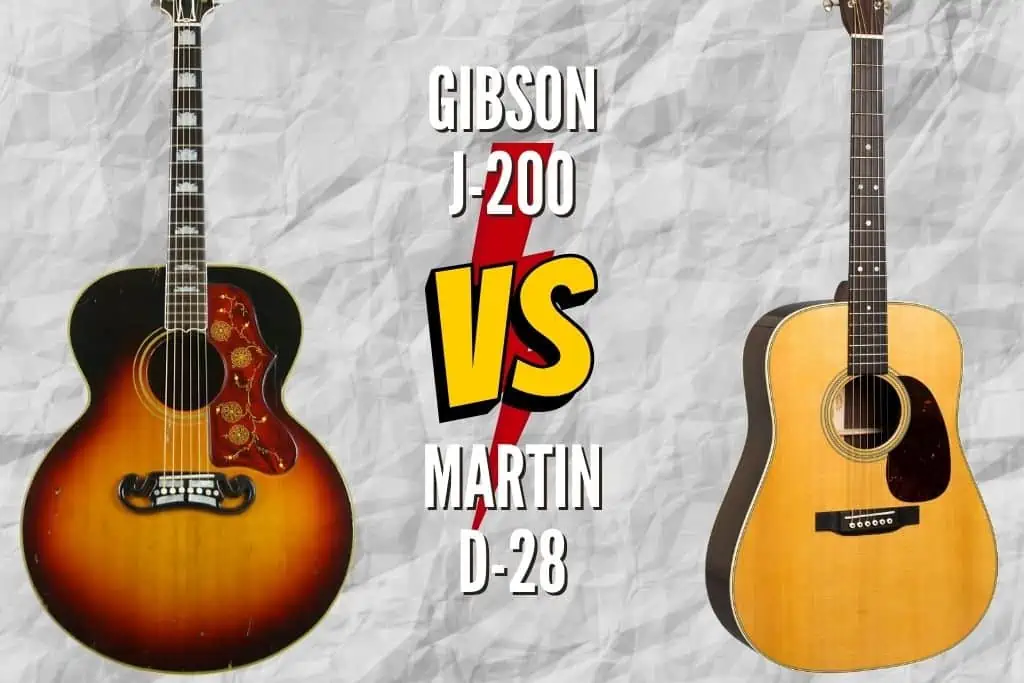
The Gibson J-200 is the “Las Vegas” of guitars. You get the iconic Moustache bridge, the engraved tortoise pickguard, and the Mother-of-Pearl “Crown” inlays. It’s a statement piece. When you walk on stage with a J-200, people notice before you even play a note.
The Martin D-28 is the “Little Black Dress.” It’s understated elegance. Dot inlays, a simple multi-stripe rosette, and that classic squared-off headstock. It screams “pro” without needing to shout.
The Expert Verdict: Which One is For You?
Choosing between these two isn’t about which is “better”—it’s about the job you need to do.
Buy the Gibson J-200 if…
You are a solo performer who needs a guitar to act as a full rhythm section.
You want a “dry,” punchy sound that records exceptionally well without “boomy” interference.
You love the visual heritage of the Golden Era of Country and Rock & Roll.
Buy the Martin D-28 if…
You are a Bluegrass or Folk player who needs to “cut” through a mix of mandolins and fiddles.
You prefer tonal complexity and the rich, dark resonance of Rosewood.
You want the industry standard—a guitar that has been used on more hit records than perhaps any other instrument in history.
In my collection? I’d say you eventually need both. But if I’m headed to a campfire, I’m grabbing the Martin. If I’m heading to a stadium stage, I’m taking the Gibson.