
By Julian Vance (Editor-in-Chief)
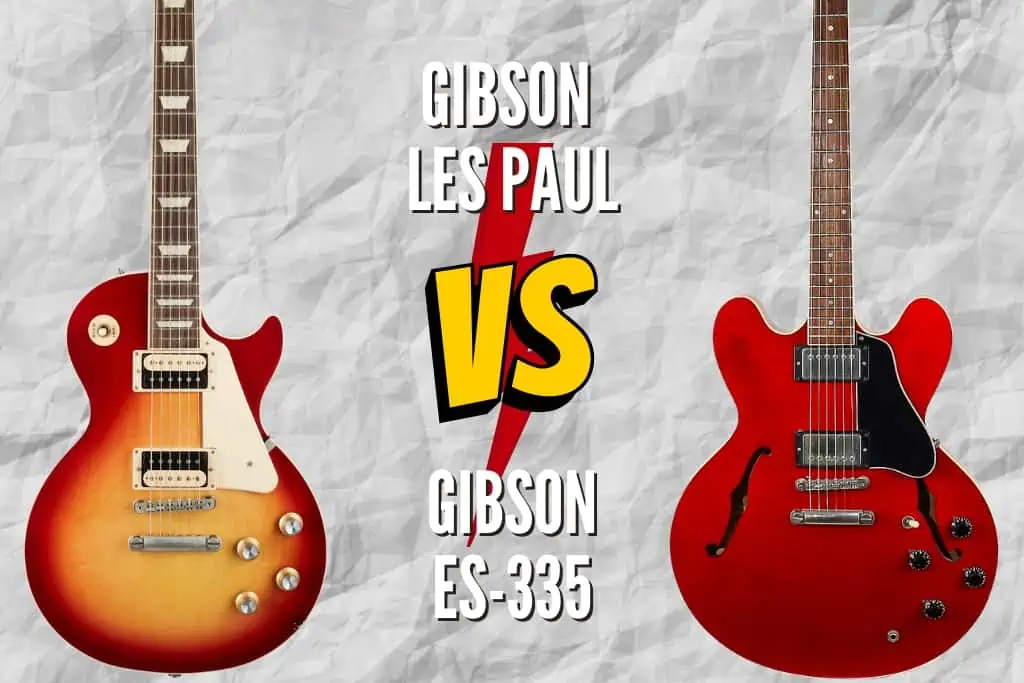
As a lifelong guitar nerd who has spent way too many hours (and dollars) in local shops and recording studios, I know that choosing between a Gibson Les Paul and a Gibson ES-335 isn’t just a gear choice—it’s a lifestyle choice. In this post, we’ll explore the differences and similarities in the Gibson Les Paul Vs ES 335 debate.
Both are absolute titans of the industry, but they couldn’t be more different under the hood. If you’re torn between the punchy sustain of a solid body and the airy resonance of a semi-hollow, I’ve broken down my hands-on experience with both to help you decide which legendary Gibson belongs in your rack.
At a Glance: Spec Comparison
Before we dive into the “feel,” let’s look at the “facts.” Here is how the modern standard versions of these icons stack up.
1. The Body: Solid vs. Semi-Hollow
The most obvious difference is how these guitars are built.
The Les Paul is a solid slab of mahogany topped with maple. It is dense, heavy, and built like a tank. When you strike a note, that mass translates into infinite sustain.
The ES-335 is a “Semi-Hollow.” It has a solid maple block running down the center to mount the pickups and bridge (which helps control feedback), but the “wings” are hollow. This gives it an acoustic-like “breath” that you just don’t get from a solid body.
My Take: If you’re playing high-gain metal or modern rock, the Les Paul is your best friend. If you want a guitar that “blooms” and feels alive against your ribs, the 335 is magic.
2. Tone: Punch vs. Air
In my experience, the tonal gap is wider than most people think.
The Les Paul Sound
The Les Paul is famous for its “mid-range honk.” It’s focused, tight, and aggressive. Because it’s a solid body, the notes have a fast attack. When I plug a Les Paul into a Marshall, it’s instant classic rock—thick, creamy leads and chunky rhythms that cut through a loud drummer.
The ES-335 Sound
The 335 is warmer and more “woody.” There’s a roundness to the low end and a chime in the highs that feels more “vintage.” It’s the king of clean and edge-of-breakup tones. However, be warned: at very high volumes with lots of gain, the 335 can start to howl with feedback. It’s a “good” feedback if you can control it (think Trey Anastasio), but a nightmare if you can’t.
3. Playability and Ergonomics
This is where personal preference really kicks in.
Weight: Let’s be real—Les Pauls are heavy. After a three-hour set, my shoulder definitely feels it. Most modern 335s are significantly lighter and better balanced.
Size: The 335 has a massive footprint. If you’re a smaller player, it can feel like you’re hugging a coffee table. The Les Paul is much more compact, though it feels “denser.”
Upper Fret Access: The 335’s double-cutaway design makes reaching the 22nd fret a breeze. The Les Paul’s single cutaway is iconic, but it’s always been a bit of a reach for those high-register solos.
4. A Quick Trip Through History
Both guitars were born from a need to innovate, but they addressed different problems.
The Les Paul (1952): Named after the legendary guitarist, this was Gibson’s answer to the “feedback” problem of hollow bodies. It was designed to be the ultimate professional tool for the new era of amplified music.
The ES-335 (1958): Designed by Ted McCarty, this was the “Goldilocks” guitar which was intended to bridge the gap between the feedback-prone archtops of the jazz era and the heavy solid bodies of the rock era. It succeeded brilliantly.
5. The Legends: Who Plays What?
Sometimes, we choose with our eyes and ears based on our heroes.
Team Les Paul: Think Slash (GNR), Jimmy Page (Led Zeppelin), and Randy Rhoads. These players need power, sustain, and that “heavy” rock attitude.
Team ES-335: Think B.B. King (and his modified “Lucille”), Larry Carlton (Mr. 335), and Dave Grohl (whose signature DG-335 is a modern staple). These players value versatility and a “vocal” quality to their notes.
The Verdict: Which One Should You Buy?
After years of flipping between the two, here is my honest advice:
Choose the Gibson Les Paul if: You want the ultimate rock machine. You need maximum sustain, you play with high gain, and you don’t mind a bit of extra weight for the sake of that legendary “punch.”
Choose the Gibson ES-335 if: You want a versatile, “sophisticated” tone. You play anything from jazz to alternative rock, and you want a guitar that feels more responsive and resonant. Plus, it looks incredible in a suit or a t-shirt.
Expert Tip: Don’t just read the specs. Go to a shop, sit down, and play them back-to-back through the same amp. Your ears will tell you which one is “the one” within five minutes.
Which side of the Gibson fence do you land on—the solid-body powerhouse or the semi-hollow classic? Let me know in the comments!