

By Marcus Thorne (Education Lead)
Whether you’re a bedroom hobbyist or a seasoned gigging pro, you’ve likely spent thousands of hours staring at the same six notes: E-A-D-G-B-E.
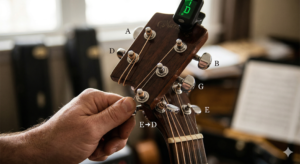
In my years of playing and obsessing over gear, I’ve often asked myself: Why this specific arrangement? Why not all perfect fourths? Why did we settle on a tuning that requires a weird “hiccup” between the G and B strings?
As a guitar enthusiast, I’ve dissected the history and the “why” behind EADGBE. If you’re looking to understand the logic of the fretboard or wondering if it’s time to break away from tradition, here is my deep dive into the evolution, mechanics, and mastery of guitar tuning.
The Evolution: From Lutes to the Modern Legend
The guitar didn’t just appear out of thin air; it’s the result of centuries of “survival of the fittest” in the instrument world. When I look back at the Renaissance and Baroque eras, the tuning landscape was like the Wild West.
Predecessors and the “Almost” Standards
Before the six-string we know today, we had:
The Lute: Typically tuned E-A-D-F#-B-E. If you look closely, that’s almost modern standard tuning, but with the “third” moved one string higher.
The Vihuela: Often tuned G-C-F-A-D-G.
These instruments were beautiful, but they often lacked the projection and structural integrity needed for modern performance.
The Torres Revolution
In my opinion, the most pivotal moment in guitar history happened in the 19th century with Antonio de Torres Jurado. Torres didn’t just change the body shape; he effectively standardized the 650mm scale length and the EADGBE tuning. By doing this, he gave us a balanced tension across the neck that allowed for the complex, resonant compositions of the Romantic era.
The Geometry of Sound: Why EADGBE Works
If you’ve ever tried to tune a guitar to all fourths (E-A-D-G-C-F), you’ve realized the problem immediately. While your scales become perfectly symmetrical, your chords become a nightmare.
The “Major Third” Secret
Standard tuning is built on perfect fourths, with one exception: the interval between the G (3rd string) and B (2nd string) is a major third.
From a player’s perspective, this is a stroke of genius for two reasons:
Chording: It allows you to play a standard six-string “barre chord.” Without that major third interval, your fingers would have to stretch across five or six frets just to play a simple Major triad.
The “Top E” Symmetry: By dropping that interval to a third, the high string returns to an E. This means your scales and chord shapes are framed by the same note on the top and bottom, making navigation intuitive.
Expert Tip: If we used the “EADGCF” tuning, the half-step interval between E and F would create a dissonant “rub” that makes open-position folk and classical playing nearly impossible to voice cleanly.
Why I Still Stick to Standard (Mostly)
In an age where everyone is chasing “polyphia-style” technicality or “heavy-as-hell” drop tunings, there is a reason EADGBE remains the king.
Ergonomic Efficiency: Standard tuning minimizes “fretting hand travel.” You can reach almost any diatonic chord within a four-fret box.
Harmonic Balance: The distribution of notes allows for a rich “piano-like” resonance when playing open chords.
The Learning Curve: 99% of all educational material—from Mel Bay to YouTube—is written for this tuning. If you want to communicate with other musicians, this is our shared language.
Breaking the Rules: When to Go Alternative
While I love standard tuning, my creative “aha!” moments often come when I twist the pegs. Based on my experience, here is how I categorize the “Big Three” of alternative tunings:
The Icons Who Changed the Game
We can’t talk about tuning without mentioning the masters who used it as a signature:
Jimi Hendrix (Eb Standard): By tuning down a half-step, Jimi got a “darker” tone and easier string bends. It’s a trick I use to make a stiff Stratocaster feel “buttery.”
Keith Richards (Open G): Keith famously removed his 6th string and stayed in Open G, creating the most iconic riffs in Rock history.
Joni Mitchell: She is the queen of “random” tunings, often using them to find voicings that were physically impossible in EADGBE.
Final Thoughts: The Standard is the Foundation
Standard tuning isn’t a limitation; it’s a highly evolved system designed for the human hand. It provides the perfect balance between the math of music theory and the physical reality of four fingers and a thumb.
If you’re a beginner, master EADGBE first. It is the map of the musical world. But once you know the map, don’t be afraid to go off-road—that’s where the real magic happens.
What’s your go-to tuning? Do you stick to the classics, or are you currently lost in the world of DADGAD? Let’s talk about it in the comments.