
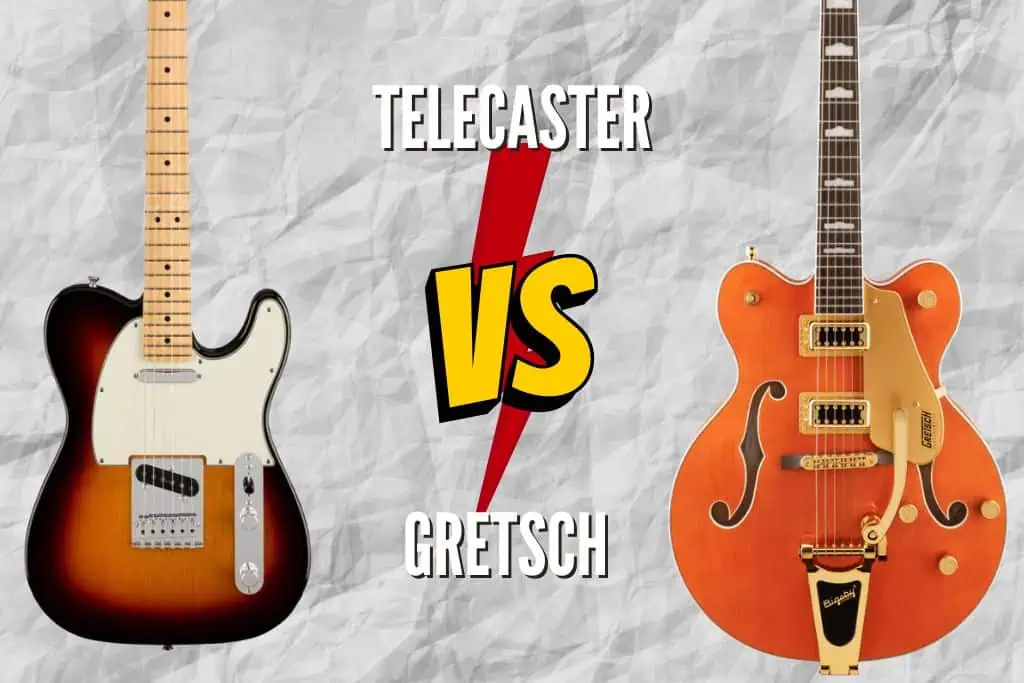
Fender Telecaster v Gretsch: The Ultimate Tone & Feel Comparison
When discussing electric guitar history, Fender and Gretsch are the titans of tone. While Gibson and Fender often dominate the conversation, the rivalry between the utilitarian Fender Telecaster and the ornate Gretsch (specifically their hollow-body lineup) offers a more interesting contrast in philosophy, sound, and feel.
If you are torn between the “twang” of a Tele and “That Great Gretsch Sound,” you aren’t just choosing a guitar; you are choosing a sonic landscape.
Key Takeaways
The Mix: The Telecaster cuts through a dense mix with high-end spike; the Gretsch fills space with woody, airy warmth.
The Feel: The Telecaster has a longer scale length (25.5″), creating higher string tension. The Gretsch is shorter (typically 24.6″), offering a “slinkier” feel.
The Hardware: Telecasters are famous for indestructible, simple stability. Gretsch guitars often feature complex Bigsby vibrato systems which require more maintenance.
Construction: The Plank vs. The Box
The fundamental difference lies in the chassis.
The Fender Telecaster is the definition of “form follows function.” It is essentially a solid plank of wood (usually Alder, Ash, or Pine) bolted to a Maple neck. There are no hiding places with a Telecaster. Its solid-body construction provides immediate attack and incredible sustain.
The Gretsch lineup (focusing on icons like the 6120 or Electromatic hollow-bodies) is the opposite. They utilize laminated maple construction, often fully hollow or with a center block. This adds an acoustic “air” to the note decay that a solid body simply cannot replicate.
The Scale Length Factor (Crucial for Playability)
Correction to common misconceptions: The Telecaster features a 25.5″ scale length. This creates higher string tension, giving the guitar a “snap” and making it ideal for drop tunings or percussive playing.
Conversely, most Gretsch models utilize a 24.6″ scale length. This lower tension makes bending strings easier and chords feel slightly closer together, though it can feel “loose” to players used to the fight of a Fender.
Comparison Table: The Specs
Based on the standard Fender Player Series Telecaster vs. Gretsch G5420T Electromatic (The most common comparison point).
Tone Profile: Twang vs. Growl
The Telecaster Sound
The Telecaster is the industry standard for clarity. The bridge pickup is mounted directly into a metal plate, creating a magnetic field that produces a sharp, ice-pick treble that defines country lead guitar. However, the neck pickup is surprisingly warm and jazzy.
Best for: Modern Country, Math Rock, Indie, Funk, and Punk.
Sonic Signature: “Spank,” “Twang,” and “Chime.”
The Gretsch Sound
Gretsch guitars don’t just use standard humbuckers; they use Filter’Trons. These are lower output than a Gibson humbucker, sitting somewhere between a single-coil and a full humbucker. They offer a unique “growl” when overdriven and a shimmering, glass-like top end when clean.
Best for: Rockabilly, Worship music, Beatles-esque Pop, Classic Rock.
Sonic Signature: “Woody,” “Airy,” and “Gritty.”
Hardware & Maintenance: Simplicity vs. Complexity
This is where the ownership experience diverges significantly.
The Telecaster is widely regarded as the most durable guitar ever made. You can drop it, tour with it, and rarely need to adjust it. The fixed bridge means tuning stability is rock solid.
The Gretsch is a high-maintenance relationship. The Bigsby B60 or B6 vibrato tailpiece creates beautiful, shimmering pitch bends, but it introduces friction points. If the nut slots aren’t cut perfectly, a Gretsch can go out of tune with heavy use. However, for many players, the expressive capability of the Bigsby is worth the extra setup time.
The Verdict: Which one fits your style?
Choose the Fender Telecaster if:
You need to cut through: If you play in a band with a loud drummer or another guitarist using humbuckers, the Tele will ensure you are heard.
You are a rough player: If you hit the strings hard and want a guitar that can take a beating.
You love modifications: The Telecaster is modular; swapping pickups, necks, and bridges is incredibly easy.
Choose the Gretsch if:
You want “texture”: If you play rhythm guitar and want a sound that fills the room with harmonic complexity.
You play with dynamics: The hollow body responds to the volume of your amp—controlled feedback is a musical instrument in itself on a Gretsch.
Visuals matter: Let’s be honest—nothing looks as cool on stage as a big orange Gretsch.
FAQ
Is a Gretsch harder to play than a Telecaster? Not necessarily. The Gretsch has lower string tension due to the shorter scale length, making bends easier. However, the body is physically larger and thicker, which can feel cumbersome for smaller players compared to the slim Telecaster.
Can a Telecaster do jazz? Absolutely. In fact, the Telecaster was famously used by jazz legends like Ed Bickert. By rolling off the tone knob on the neck pickup, the Telecaster produces a convincing, dark jazz tone.
Why does my Gretsch go out of tune? This is usually due to the Bigsby vibrato. To fix this, ensure your strings are stretched properly and consider lubricating the nut slots with graphite (or pencil lead) to prevent string binding.