
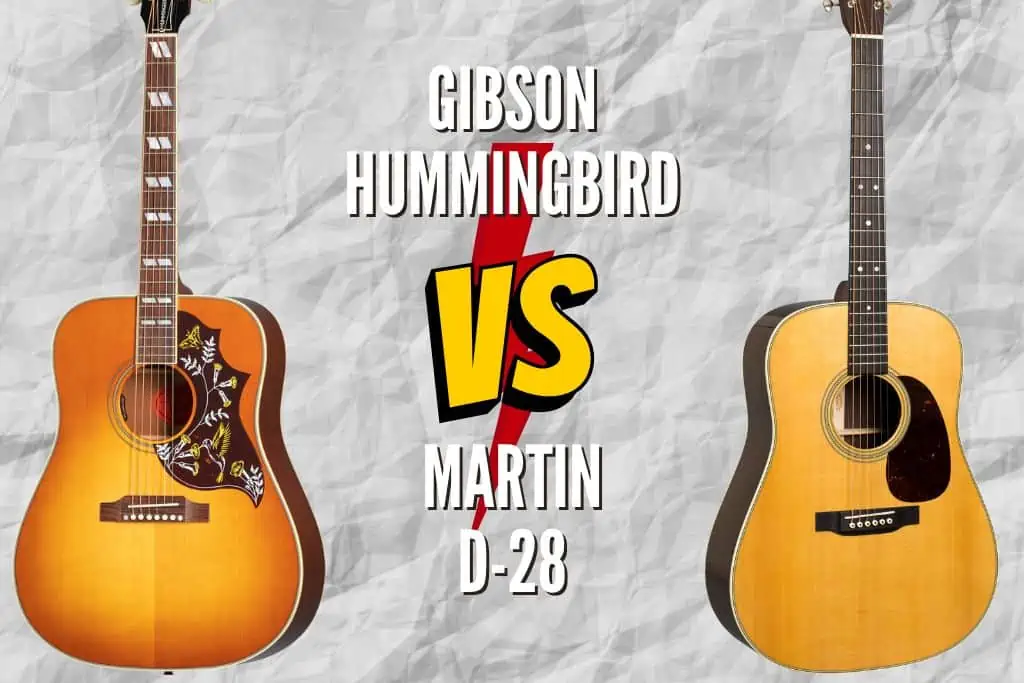
When it comes to creating top-of-the-line instruments, Gibson and Martin are the names that will most likely pop up first in the guitarist’s mind. For guitar enthusiasts, comparing the Martin D28 to the Gibson Hummingbird can be tough. Both are iconic instruments that have stood the test of time. Picking between the two can be challenging. This is since both are renowned for their exceptional sound and excellent artistry. In the debate of Gibson Hummingbird vs Martin D28, both guitars offer distinct tonal qualities and craftsmanship.
One of the key differences between these guitars, when considering the Gibson Hummingbird and Martin D28, is their construction and hardware. The Hummingbird has a solid Sitka spruce top with mahogany back and sides, while the D28 has a solid Sitka spruce top with East Indian rosewood back and sides. This gives the Hummingbird a warmer, more mellow sound. Conversely, the D28 has a brighter, more balanced sound.
Considering the tone that Hummingbird produces, this makes it well-suited for strumming and fingerpicking. It’s particularly popular among folk and country musicians. The Martin D28, on the other hand, has a brighter, more balanced sound. It comes with a strong low end and clear highs making it a versatile guitar that can handle a variety of playing styles and genres.
| Gibson Hummingbird | Martin D28 | |
| Body Shape | Square Shoulder Dreadnought | Dreadnought |
| Body Wood | Sitka Spruce, Mahogany | Sitka Spruce, Solid East Indian rosewood |
| Neck Shape | Round profile | Modified low oval |
| Neck Wood | Mahogany | Select hardwood |
| Neck Construction | Set neck | Dovetail |
| Fretboard Material | Rosewood | Ebony |
| Scale Length | 24.75” | 25.4” |
| Number Of Frets | 20 | 20 |
| Frets Material | Nickel | Nickel |
| Type of Bridge | Fixed | Fixed |
| Tuning Machines | Grover Rotomatics | Nickel open-gear |
| Weight | 4.5 – 5.5 lbs (2.04 – 2.49 kg) depending on the model | 4.5 – 5.5 lbs (2.04 – 2.49 kg) depending on the model |
When evaluating these musical icons, Gibson Hummingbird vs Martin D28, renowned musicians such as Bob Dylan, Elvis Presley, and Keith Richards have played both guitars, which boast of significant heritage. Choosing between the Hummingbird and D28 can be a difficult decision, as both guitars are known for their exceptional sound and quality craftsmanship.
Construction & Hardware Compared
The Gibson Hummingbird and Martin D28 are both built with high-quality materials and craftsmanship. The Gibson Hummingbird features a square-shoulder dreadnought body shape with a mahogany back and sides and a Sitka spruce top. The neck is made of mahogany and features a round profile, while the fretboard is made of rosewood. The bridge is traditionally belly up and is made of rosewood. The tuning machines are Grover Rotomatics, which are known for their precision and stability.
On the other hand, the Martin D28 features a dreadnought body shape with a solid East Indian rosewood back and sides and a Sitka spruce top. The neck is made of select hardwood and features a modified low oval profile with a high-performance taper. The fretboard is made of ebony, and the bridge is ebony belly-style with a drop-in saddle. The tuning machines are nickel open-gear tuners with butterbean knobs.
While both guitars are made with high-quality materials, when comparing Gibson Hummingbird vs Martin D28, the construction and hardware differ slightly. The Gibson Hummingbird features a set neck construction, while the Martin D28 features a simple dovetail neck joint. The Martin D28 also features a bone nut and saddle,.
Tone Compared
When it comes to tone, the Hummingbird and D28 have distinct differences that are worth noting. The Gibson Hummingbird has a warm and mellow sound with a strong midrange and a slightly scooped low end. This makes it ideal for fingerpicking and strumming. Additionally, it’s particularly popular among folk and country musicians. The mahogany back and sides contribute to the warm tone. Meanwhile, the solid Sitka spruce top adds brightness and clarity to the sound.
In contrast, the Martin D28 has a more balanced sound with a strong low end and clear highs. It’s a versatile guitar that can handle a variety of playing styles and genres. The East Indian rosewood back and sides contribute to the deep bass response. At the same time, the solid Sitka spruce top provides clarity and projection.
For those comparing the warmth of one with the clarity of the other, the Hummingbird’s warm and mellow tone makes it a great choice for singer-songwriters and solo performers, as it provides a rich and full sound that doesn’t overpower vocals. On the other hand, the D28’s balanced tone makes it a great choice for playing with a band or in a recording studio, as it can cut through a mix and provide a strong foundation for other instruments.
Feel & Playability Compared
The Gibson Hummingbird has a slightly slimmer neck profile compared to the Martin D28, which may make it a more comfortable option for players with smaller hands. The Hummingbird also features a larger body than the D28, which can make it feel a bit more cumbersome to play for some players. This is particularly true for those who are used to smaller-bodied instruments.
On the other hand, the Martin D28 has a slightly wider neck profile, which can make it a more comfortable option for players with larger hands. It also has a longer scale length, which can make it feel more responsive and dynamic. This is particularly beneficial for players who prefer a more nuanced playing style.
Both guitars are well-built and offer exceptional playability. The Hummingbird’s larger body may require more effort to play for some players. When considering playability, the D28’s slightly smaller body can provide a more comfortable playing experience. However, it may lack some of the depth and resonance of the Hummingbird.
Looks Compared
Comparing the looks of these legendary pieces raises the eternal question of which one is more appealing. It’s difficult to answer simply because everyone will have their preference. When evaluating Gibson Hummingbird vs Martin D28, players will find some feature of the instrument more soothing to their eyes.
When it comes to aesthetics, both the Hummingbird and D28 are stunning instruments. The Hummingbird features a distinctive pickguard with a hummingbird design. In contrast, the D28 has a more understated appearance with a simple pickguard.
The Hummingbird also has more ornate inlay work on the fretboard and headstock, while the D28 has a more traditional and simple look. Ultimately, when choosing between Gibson Hummingbird and Martin D28, the choice may come down to personal preference. This is especially true in terms of aesthetics.
Conclusion
To sum up, both the Gibson Hummingbird and Martin D28 are excellent guitars with their own unique qualities and strengths. Opting for Gibson Hummingbird vs Martin D28 depends on individual preferences, playing style, and intended use.
If you’re seeking a guitar with a full and rich tone, and are comfortable with a slightly larger body, then the Gibson Hummingbird might be the right choice. Conversely, if you value comfort and a more responsive playing experience, then the Martin D28 may be the better option.
However, both of these guitars are renowned instruments that have been cherished by musicians for many years. They are both expertly constructed with exceptional playability. Their sound will endure for years. Ultimately, Gibson Hummingbird vs Martin D28 can be best decided by testing them out for yourself and choosing the one that resonates with you.