

How Long Should You Practice Guitar? The Science of Effective Improvement
Fender’s famous study revealed a harsh truth: 90% of new guitarists quit within the first year. The culprit isn’t a lack of talent; it is a lack of progress. And progress stalls when “playing” is mistaken for “practicing.”
If you are asking, “How many hours should I play?”, you are asking the wrong question. The correct question is: “How effectively am I using the time I have?”
Key Takeaways
The “Noodling” Trap: “Playing” (jamming what you know) maintains your current level. “Practicing” (struggling with new concepts) raises your level.
The 15-Minute Minimum: You need at least 15 minutes daily to maintain calluses and muscle memory.
Frequency > Duration: 30 minutes daily is superior to a 4-hour binge on Sunday. The brain requires sleep cycles to encode muscle memory.
 The Core Concept: Playing vs. Practicing
 The Core Concept: Playing vs. Practicing
To improve, you must distinguish between these two mindsets.
1. Practicing (The Gym) This is Deliberate Practice. It requires high mental energy. You are analyzing mistakes, slowing down the BPM (Beats Per Minute) on a metronome, and working on techniques that feel uncomfortable.
Goal: Problem-solving and skill acquisition.
Feeling: Frustrating, focused, tiring.
2. Playing (The Game) This is the reward. You are using the skills you acquired to create music, improvise, or jam along to tracks you already know.
Goal: Expression and enjoyment.
Feeling: Relaxing, flowing, fun.
The Golden Rule: If you sound good while you are “practicing,” you are actually just “playing.” Real practice usually sounds repetitive and broken.
How Much Time Do You Actually Need?
Your practice duration should align with your end goal. Here is a realistic breakdown:
Expert Note: Practicing more than 4 hours a day yields diminishing returns due to mental fatigue and physical risk (tendonitis).
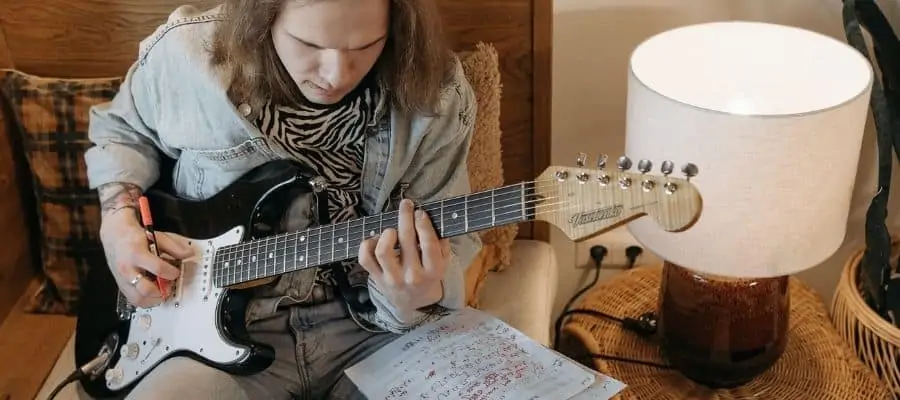
The Anatomy of a Perfect Session
Whether you have 30 minutes or 2 hours, structure is the key to efficiency. Do not just pick up the guitar and strum.
1. The Setup (Atmosphere)
- Eliminate Distractions: Phone away, TV off.
Essential Gear: Metronome (non-negotiable for timing), Tuner, and a Practice Journal.
Tune Up: Never practice on an out-of-tune guitar; it trains your ear to accept bad pitch.
2. The Warm-Up (5 Minutes)
Do not jump straight into a difficult solo. Get the blood flowing to prevent injury.
Drill: Spider Exercises (1-2-3-4 across all strings) or chromatic scales. Focus on relaxing the shoulders and wrists.
3. The “Deep Work” (The Core)
This is where you attack your weaknesses.
For Beginners: Chord transitions (clean switching between C, G, and D), strumming consistency.
For Intermediates: Scales (Major, Minor Pentatonic), Arpeggios, and basic improvisation.
For Advanced: Complex jazz voicings, sweep picking, ear training (transcribing).
4. The Reward (The End)
End every session by playing something you love. This leaves your brain with a positive association, making you more likely to pick up the guitar tomorrow.
Realistic Timelines: What to Expect
The internet is full of “Master Guitar in 3 Months” scams. Here is the reality of the learning curve.
In 3 Months (Consistently): You will not be a master. You will have calluses, solid open chords, and the ability to play through full songs rhythmically. You should be able to play the Minor Pentatonic scale box 1.
In 1 Year (Consistently): You can handle barre chords (F major, B minor), understand basic music theory, and perhaps improvise a simple solo.
The 10,000 Hour Rule: Malcolm Gladwell’s theory suggests 10,000 hours to reach “mastery.” While debated, the principle stands: Talent is simply the result of thousands of hours of unseen work.
Routine Breakdowns by Level
The Beginner Routine (30 Mins)
Warm-up (5m): Finger stretching.
Chords (10m): “Perfect repetitions” of changing between Open Chords.
Rhythm (10m): Strumming patterns with a metronome.
Fun (5m): Play a song you like.
The Intermediate Routine (60 Mins)
Technique (15m): Alternate picking drills, scale runs.
Theory/Fretboard (15m): Learning triads, memorizing notes on the neck.
Repertoire (20m): Learning a new song (not one you already know).
Improvisation (10m): Jamming over a backing track using the scales you practiced.
FAQ
 FAQ
FAQCan I practice too much? Yes. If you feel pain in your wrist, forearm, or fingertips (sharp pain, not callus soreness), stopimmediately. Pushing through pain leads to Repetitive Strain Injury (RSI) or Carpal Tunnel, which can sideline you for months.
Is there a difference between Acoustic and Electric practice? Mentally, no. Physically, yes. Acoustic guitars generally have higher string tension (heavier gauge strings), requiring more hand strength. Electric guitars require more muting technique to control noise. However, music theory and scale shapes apply to both equally.
What if I miss a day? Don’t panic. Life happens. However, avoid the “Weekend Warrior” mentality (skipping Monday-Friday and playing 5 hours on Saturday). It is better to play for 10 minutes every day than to binge once a week. Consistency builds neural pathways; binging just causes fatigue.