

Standing vs. Sitting: How You Should Actually Practice Guitar
By Gecko Guitars
I will never forget my first “real” band rehearsal.
I had spent six months in my bedroom, sitting on the edge of my bed, perfecting the solo to “Whole Lotta Love.” I could play it flawlessly. But when I walked into the rehearsal room, strapped my Les Paul on, and stood up to play… I fell apart.
My fingers couldn’t reach the frets. My wrist hurt. I couldn’t see the fretboard. I sounded like a total beginner.
This is what I call “The Bedroom Guitarist Trap.”
The debate over practicing sitting down vs. standing up isn’t just about comfort—it’s about biomechanics. The angle of your wrist changes entirely when you stand up. If you only ever practice one way, you are limiting your growth.
Here is my honest breakdown of the pros and cons of both, and the “Golden Rule” I use to bridge the gap.
The Case for Sitting: The “Laboratory” Mode
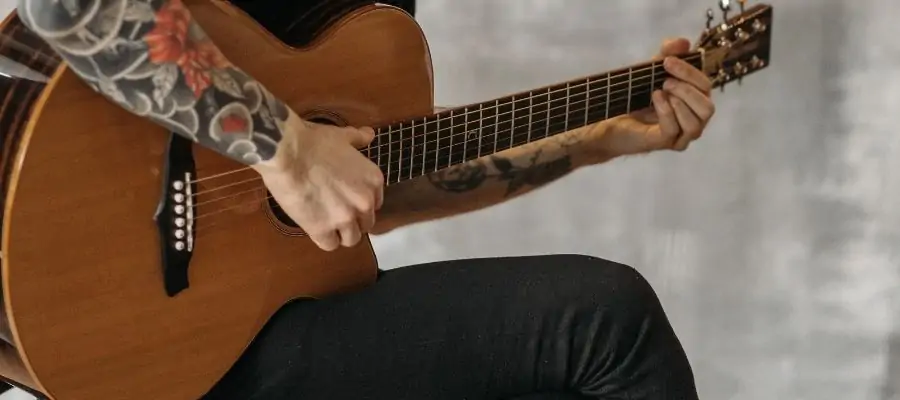
When I am learning something brand new—like a complex jazz chord shape or a fast sweep-picking run—I sit down.
The Pros: Precision & Focus
Stability: When the guitar is resting on your leg, it isn’t moving. This allows you to focus 100% of your brainpower on your left-hand finger independence and right-hand picking accuracy.
Visual Aid: Let’s be real—it is much easier to see the fretboard when it’s right under your nose. For beginners learning the pentatonic scale for the first time, this visual feedback is crucial.
Endurance: You can practice for three hours sitting down. Standing with a 9lb Gibson Les Paul for three hours? That’s a workout.
The Cons: The “Slouch” & The Wrist
The “Casual” Posture Trap: Most people sit with the guitar on their right leg (if right-handed). This forces your right shoulder up and twists your spine. It also forces your fretting wrist into a harsh bend to reach the low E string. This is a recipe for Carpal Tunnel.
Vocal Compression: If you sing, sitting collapses your diaphragm. You simply cannot project your voice properly while hunched over a Stratocaster.
The Case for Standing: The “Performance” Mode
If you ever plan to play outside your bedroom—whether at a church, a bar, or a campfire—you need to practice standing up.
The Pros: Stage Readiness
The “Real” Feel: Playing standing up requires you to balance the neck with your fretting hand slightly (unless your guitar is perfectly balanced). You need to get used to the guitar shifting against your body as you move.
Better Breathing: Standing aligns your spine and opens your diaphragm. If you are a singer-songwriter, standing is non-negotiable for vocal power.
Rock & Roll Energy: You can’t move, sway, or feel the groove when you are glued to a chair. Standing allows you to physically express the music.
The Cons: The “Blind” Spot
Visibility: When you stand, the fretboard tilts away from you. You have to learn to navigate by feel and by looking at the side dots, rather than looking directly at the face of the fretboard.
Fatigue: It takes physical stamina. Your back and shoulders will get tired.
The Golden Rule: How to Fix the Transition
The number one reason guitarists fail to play well standing up is Strap Height.
We all want to look cool. We all want to wear the guitar low like Jimmy Page or Slash. But if you practice sitting down (where the guitar is high on your chest) and then stand up and drop the guitar to your knees, your wrist angle changes by 90 degrees. Your muscle memory becomes useless.
My Solution: The “Hybrid” Setup
Sit down with your guitar in your preferred playing position.
Adjust your guitar strap so it is tight against your shoulder while you are sitting.
Stand up.
The guitar should not move. It should stay at the exact same height standing as it was when you were sitting.
Yes, this might look a bit “high” (think Tom Morello or The Beatles), but it ensures that your wrist mechanics are identical whether you are sitting or standing.
Final Verdict: My Recommended Routine
So, which should you do? Both.
Here is the split I recommend to my students to ensure they are technically precise but stage-ready:
1. The “Learning Phase” (Sitting): When I am mapping out a new song, learning a solo, or studying theory, I sit. I usually sit in the Classical Position (guitar between my legs, rather than on the right leg). This mimics the standing angle better and saves my back.
2. The “Rehearsal Phase” (Standing): Once I know the notes, I stand up. I run the song from start to finish standing. If I can’t play it standing, I haven’t mastered it yet.
3. The “Endurance Phase” (Standing): If you have a gig coming up, practice your entire setlist standing up twice in a row. You need to condition your back and shoulders to handle the weight of the instrument.
Conclusion
Don’t let your chair become your crutch. The guitar is a physical instrument. Enjoy the comfort of sitting when you are doing the “brain work,” but respect the physicality of standing when it’s time to do the “rock work.”