
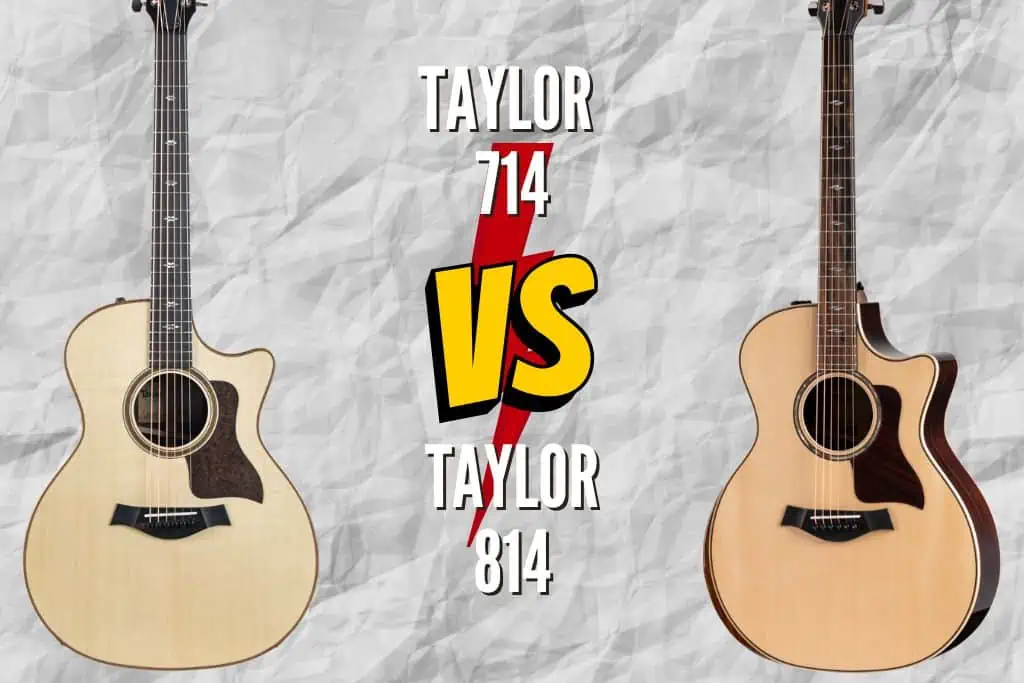
Taylor 714ce vs. 814ce: The Workhorse or The Flagship?
By Gecko Guitars
If you are looking at high-end acoustics, you eventually end up at the “Taylor Dilemma.“
You are staring at the Taylor 714ce and the Taylor 814ce. On paper, they look nearly identical. They both feature the legendary Grand Auditorium shape. They both (traditionally) sport Indian Rosewood backs and sides with Spruce tops.They both play like butter.
Yet, the 814ce commands a significantly higher price tag. Is it just for the abalone inlays, or is there something going on under the hood?
I’ve played dozens of both models, from the older X-braced versions to the modern V-Class thoroughbreds. The difference isn’t just cosmetic—it’s about voicing. Here is the no-nonsense breakdown of which one belongs in your collection.
The “Elephant in the Room”: A Note on Woods
Before we dive in, a quick expertise check: Historically, both the 700 and 800 series were Rosewood/Spruce guitars.However, Taylor recently shifted the new 700 series to Hawaiian Koa.
This guide compares the traditional Rosewood 714ce (which is plentiful on the used market and what most people are cross-shopping) against the 814ce. If you are looking at a brand-new 714ce, you are looking at a Koa guitar—which is a totally different animal.
1. The Specs: What’s Actually Different?
2. Tone: “Earthy” vs. “High Fidelity”
This is where the magic happens. While they share DNA, Taylor voices these two series differently.
The 814ce Sound (The “Grand Piano”)
The 814ce is Taylor’s flagship for a reason. It is designed to be the ultimate modern acoustic.
The Vibe: It has a “scooped” midrange. You get deep, tight lows and sparkling, bell-like highs.
The Experience: When you strum an open G chord, it sounds like a grand piano. It is incredibly articulate. Every note separates clearly. This is why studio engineers love it—it sits in a mix perfectly without needing much EQ.
The 714ce Sound (The “Americana”)
The 714ce is often described as the “sibling with the soul.“
The Vibe: It typically pushes the midrange forward more than the 814. It has a “woodier,” warmer attack.
The Top Wood Factor: Many 714s utilize Lutz Spruce rather than Sitka. Lutz is a hybrid that mimics the sound of “aged” wood. This gives the 714ce more headroom and a slightly vintage growl that the pristine 814ce lacks.
3. Playability: Debunking the Neck Myth
There is a common misconception online (seen in many AI-generated articles) that the 814 has a wider neck than the 714.This is generally false.
Both guitars feature Taylor’s standard 1-3/4″ nut width and the famous Taylor neck profile. If you close your eyes, the geometry feels identical.
The Real Difference is the Texture:
The 814ce often features a slightly more refined finish treatment, and depending on the year, the back of the neck might feel smoother due to the higher-grade satin finish used to contrast the gloss body.
The 714ce feels more utilitarian. It’s fast, but it doesn’t scream “luxury” under the thumb the way the 800 series does.
Both utilize the Taylor NT (New Technology) Neck, which is bolt-on. This means if you keep the guitar for 20 years and need a neck reset, a tech can do it in 10 minutes with shims. It’s the best neck joint in the industry for longevity.
4. Aesthetics: Wood vs. Bling
This is usually the deciding factor for my clients.
The Taylor 814ce is dressed to impress. It features:
Curly Maple binding (the light wood trim around the edges).
Intricate “Element” fretboard inlays (mother of pearl).
A rosewood pickguard.
It looks expensive under stage lights.
The Taylor 714ce is understated. It usually features:
Koa or wood binding.
“Reflections” or simpler dot inlays.
Often comes in a “Western Sunburst.“
It looks like a tool for a working musician, not a museum piece.
5. Construction Nuance: The Finish
Here is a detail most people miss: The Glue and The Finish.
When Andy Powers (Taylor’s master builder) redesigned the 800 series, he introduced protein glues (animal hide glue) for the bracing to transfer vibration better. He also thinned the gloss finish down to 3.5 mils—that is thinner than a piece of paper.
The 814ce resonates against your chest in a way that cheaper guitars don’t, largely because it isn’t “suffocated” by thick plastic finish. The 714ce shares many of these traits, but the 814ce is where Taylor pushes their manufacturing technology to the absolute limit.
Final Verdict: Which One Should You Buy?
I have sold both, and I have loved both. Here is my bottom line:
Buy the Taylor 814ce if:
You want the “industry standard.“
You play a mix of strumming and fingerstyle and need a guitar that covers every frequency range with hi-fi clarity.
You appreciate the aesthetics of maple binding and gloss.
Resale value is a priority (the 814ce is the easiest high-end guitar to resell).
Buy the Taylor 714ce if:
You find the 814ce too “bright” or “glassy.“
You are a singer-songwriter. The 714’s warmer midrange leaves a perfect sonic pocket for the human voice to sit on top of.
You prefer a guitar that looks earthy and vintage rather than shiny and new.
You want 95% of the performance for about $500-$800 less on the used market.
 Tejpal Singh