
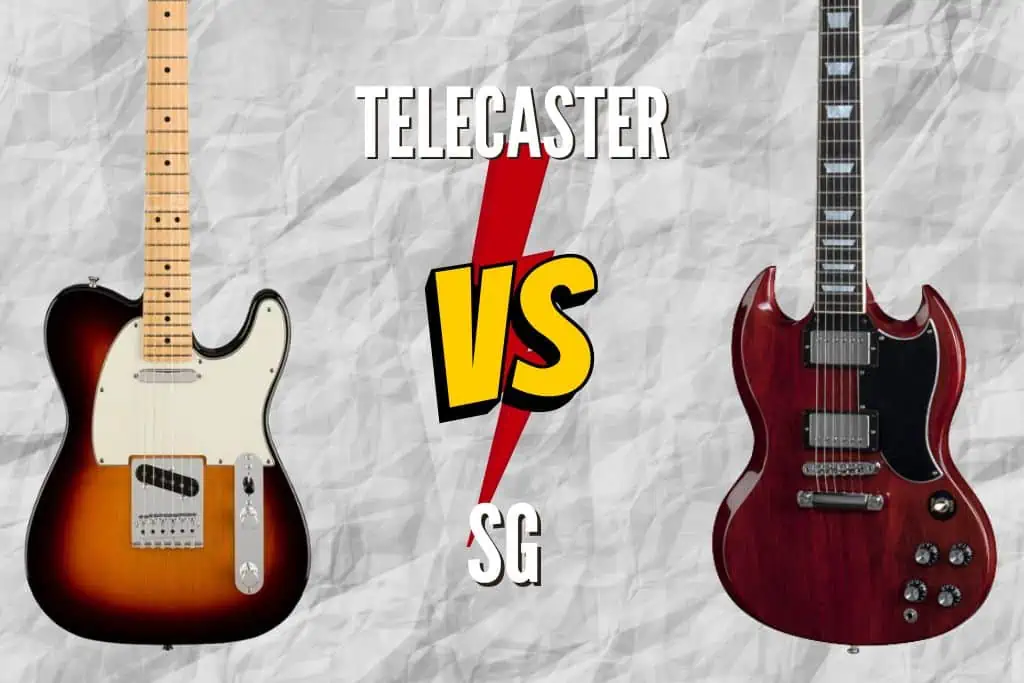
Fender Telecaster vs. Gibson SG: The Ultimate Head-to-Head Comparison
By Gecko Guitars In this article, we explore Telecaster Vs SG to help you understand their differences.
If you walk into any recording studio or backstage area, you are almost guaranteed to see two silhouettes: the utilitarian slab of the Fender Telecaster and the devil-horned contours of the Gibson SG.
I’ve spent years trading, setting up, and playing both. While marketing materials often pit them as “Country vs. Metal,” the reality is far more nuanced. They are the workhorses of the guitar world, but they achieve their status through completely opposite philosophies.
If you are torn between the snap of a bolt-on Fender and the sustain of a set-neck Gibson, this guide breaks down exactly how they differ in feel, sound, and construction based on real-world play time.
Quick Verdict: Which One Fits Your Style?
For the skimmers, here is the high-level breakdown:
Choose the Fender Telecaster if: You want clarity, tuning stability, and a guitar that can take a beating. It cuts through a mix like a knife. Ideal for Country, Indie, Math Rock, and Blues.
Choose the Gibson SG if: You want mid-range growl, lightweight comfort, and effortless upper-fret access. It pushes an amp into overdrive beautifully. Ideal for Hard Rock, Slide Blues, Doom, and Jazz Fusion.
1. Construction: The “Slab” vs. The Sculptures
The fundamental difference lies in how these instruments are built, and trust me, you feel this difference the moment you strap them on.
The Telecaster: Utilitarian Toughness
The Telecaster is essentially a cutting board with a neck. It traditionally features an Ash or Alder body paired with a Maple neck. The key factor here is the bolt-on construction. This snap-together design creates a gapless connection that transfers vibration in a very “snappy” way. It is percussive. If you drop a Telecaster, you usually worry about the floor, not the guitar.
The Gibson SG: Sleek Resonance
The SG (Solid Guitar) is a different beast. It uses a Mahogany body and neck that are glued together (set-neck). Mahogany is a porous wood that emphasizes low-mid frequencies. Because the SG is so thin (much thinner than a Les Paul or Tele), it is incredibly light. However, the glued joint provides a resonance that you feel against your ribs when you strum a chord.
My Take: The Telecaster feels substantial and indestructible. The SG feels refined and fast, though you have to be careful with the headstock—it’s the weak point of Gibson designs.
2. The Specs: Correcting the Data
Note: The original data sheet contained errors regarding standard Telecaster specs (often confusing them with Stratocasters). Below is the corrected comparison for standard models.
3. Tone: Twang vs. Growl
This is usually where people make up their minds.
The Telecaster Sound
When I plug a Tele into a tube amp, the first thing I notice is the dynamic range. It is an honest guitar—it reveals your mistakes.
Bridge Pickup: Famous for the “Tele Twang.” It’s bright, biting, and can be harsh if you don’t roll off the tone knob. It’s not just for country; Jimmy Page recorded the first Led Zeppelin album on a Tele. It cuts.
Neck Pickup: Often underrated, it produces a bell-like, smooth jazz tone that is surprisingly warm.
The Gibson SG Sound
The SG lives in the midrange frequencies. Because of the dual Humbuckers, it pushes the front end of an amp much harder than a Telecaster.
The Growl: It has a natural compression. When you play a power chord with distortion, it sounds thick and angry.
Clean Tones: People forget that the SG is unmatched for clean fingerpicking (think Derek Trucks). It has a vocal-like quality that sings rather than snaps.
4. Feel & Playability: The “Fight” Factor
As a player, this is the most critical section.
The Telecaster Scale Length (25.5″) The longer scale length on the Fender means higher string tension. You have to “fight” the guitar a little bit to bend strings. I personally love this because the strings snap back with authority. The neck profile is usually a “Deep C,” filling the hand nicely.
The Gibson SG Scale Length (24.75″) The shorter scale means less string tension. Bends are effortless; you can easily do 2-step bends without straining your fingers. However, the SG has a quirk: Neck Dive. Because the body is so light and the neck sticks out so far, the headstock tends to dip toward the floor if you let go. It requires a grippy strap to manage.
Fret Access: The SG wins here, hands down. The double-cutaway design lets you reach the 22nd fret as easily as the 5th. On a Telecaster, the blocky neck joint makes reaching the highest frets a bit of a stretch.
5. Aesthetics: Workhorse vs. Rockstar
The Telecaster looks like a tool. Whether it’s Butterscotch Blonde or Olympic White, it looks right at home in a dive bar or a church band. It says, “I’m here to work.”
The SG looks like it’s speeding even when it’s sitting on a stand. The Cherry Red finish is iconic. It is aggressive and pointy. From Angus Young (AC/DC) to Tony Iommi (Black Sabbath), the SG is the uniform of heavy riffs.
Conclusion: Which One Would I Buy?
If I could only have one, the decision comes down to the environment I am playing in.
If I am playing in a dense mix with a keyboard player and another guitarist, I am grabbing the Telecaster. Its frequency cut ensures I will be heard without turning the volume up, and its tuning stability is bulletproof for a 2-hour set.
If I am the only guitarist in a band and I need to fill up a lot of sonic space, or if I want to play lead lines that sustain for days, I am grabbing the Gibson SG.
My Advice: Don’t just look at the specs. Go to a shop, strap them both on, and stand up. Feel the neck dive of the SG and the tension of the Telecaster strings. Your hands will make the decision for you in about five minutes.